
Maryland VINE and VINELink
Victims in Maryland have a dedicated notification system called Maryland VINE, or MD4VINE. It is free. It is also confidential. The Governor's Office of Crime Prevention and Policy VINE page is the official gateway, laying out the statewide service and how to reach it. Searching online happens through VINELink. According to its public materials, the service shares custody details, court-case updates, and protective-order information whenever a participating system provides it.
A custody check answers one narrow question: what status and location the connected system reports for a specific person right now. It is not a statewide arrest feed. It is not a full case file, and it is not a place to browse booking photos or mugshots.
The Maryland VINE page gathers the service details and contact options in one spot. You can call MD4VINE at 1-866-634-8463. TTY users have a separate line at 1-866-847-1298.
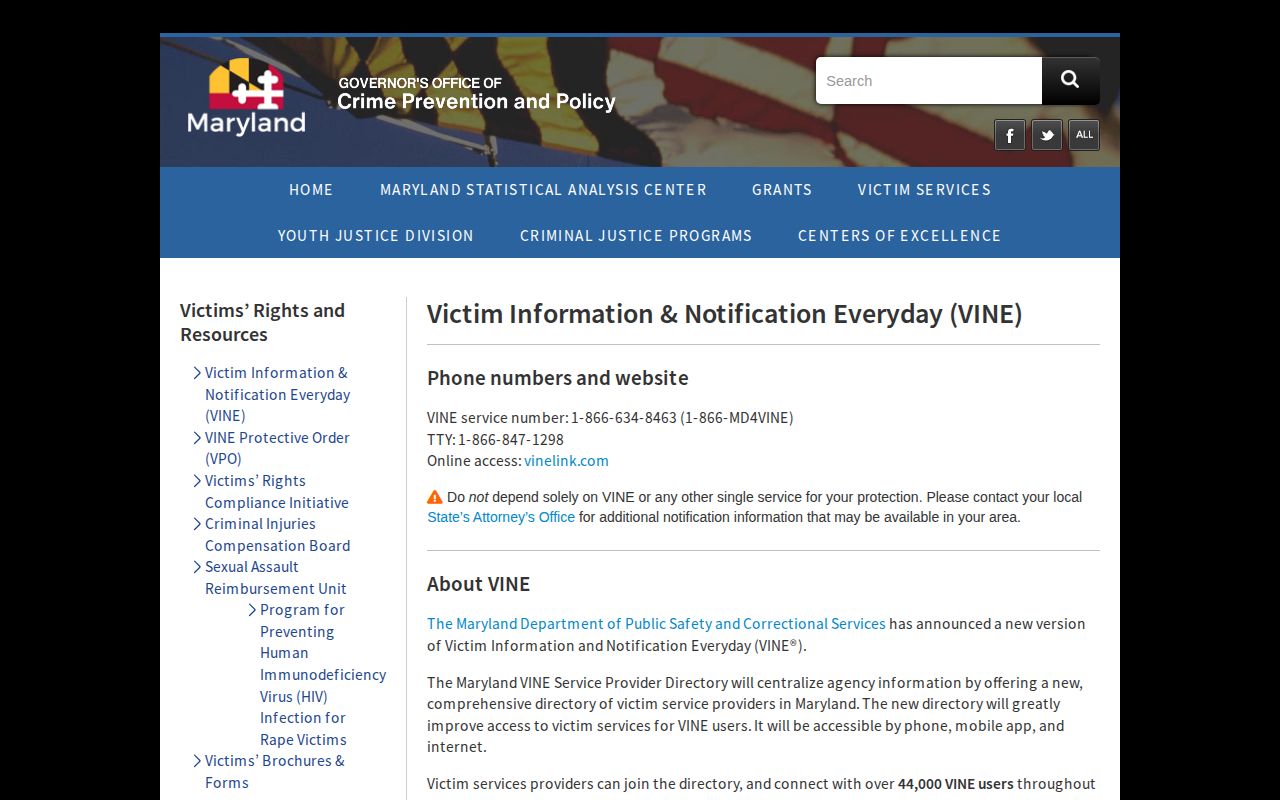
Maryland's service is MD4VINE; VINELink supplies the online search.
Check a Maryland Custody Record
Start at VINELink and pick Maryland. The neutral VINELink search page is the right place to begin a custody check. The screen works around one person or one case. Enter the name, or the offender or case number the system shows. A date-of-birth field separates people with similar names. Fresh bookings may lag, because the arresting agency has to push status data into the service. Give it time after a new arrest.
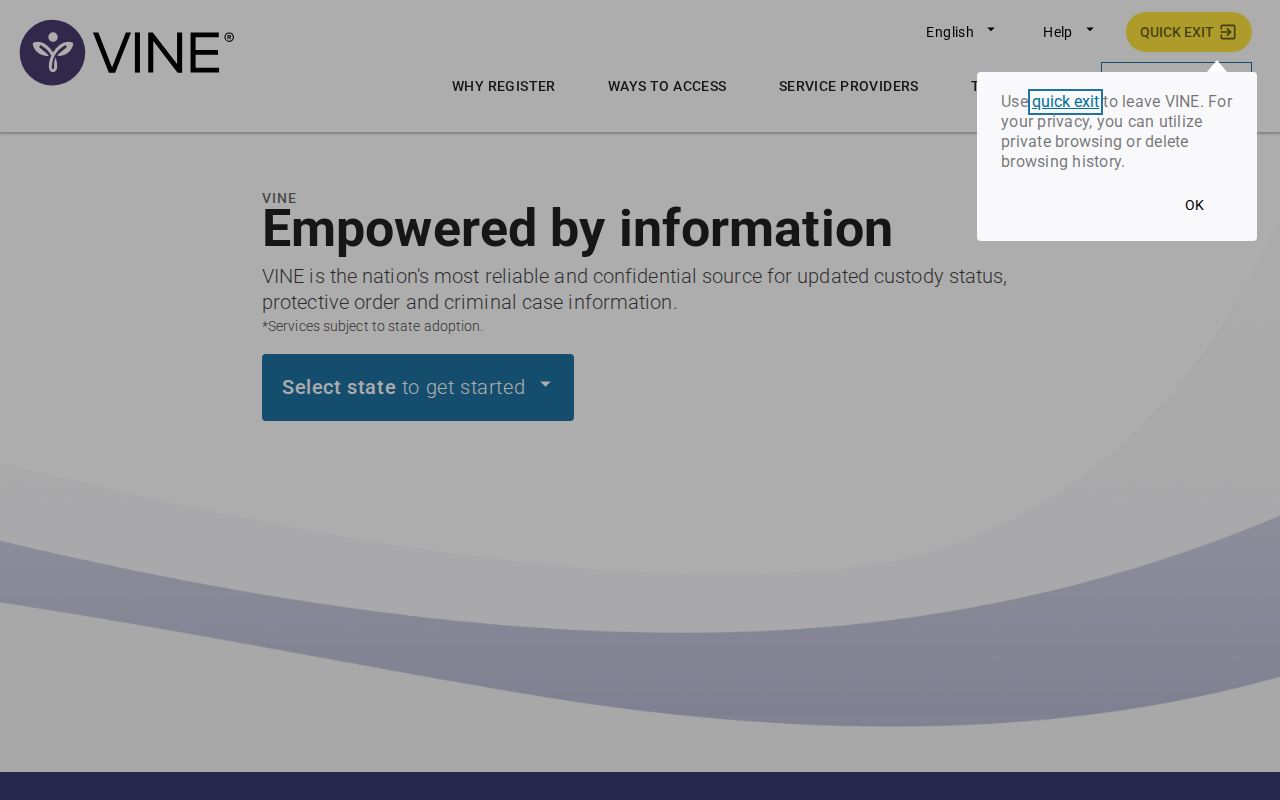
The landing view offers a person search. It does not display a statewide arrest list or a booking-photo gallery.
- Choose Maryland in the location or state selection so the query follows the Maryland VINE system.
- Enter the person's name or the offender or case number if known. Check spelling and use any extra identity field the result makes available.
- Review each match before opening it. Similar names can produce more than one record, and the correct facility and identifier matter.
- Open the likely record and read its status and location. If no match appears, try a reasonable name variation, then check the county source or contact the responsible agency.
Not sure where the arrest happened? The Maryland County Directory points a search toward the right county or Baltimore City source. A local custody page has its own pace. It may list a new booking hours before VINE catches up, or it may carry only the people still held in that one facility.
Fields in a Maryland VINE Result
What shows up depends on which jail, court, or state system is reporting. Maryland VINE materials describe custody details, court cases, and protective orders. Not every match returns every field, though. Think of a status line as the freshest update the service received. It is not a full case history.
| Result detail | What it can tell you |
|---|---|
| Person or offender identifier | Helps distinguish one record from another; compare it with the identifier shown by the relevant agency when available. |
| Custody status | Shows the status reported by the connected system, which may change after release, transfer, or another event. |
| Facility or location | Identifies a reported holding location when the source provides one; it may not describe every transfer in real time. |
| Release or status event | May show a release-related or other custody change once the participating source sends that information. |
| Case or protective-order information | May appear through supported Maryland services, but is separate from a full court file or arrest report. |
Custody changes faster than public screens do. Someone can shift from a county jail to a state facility or walk free. They may move again while the listings lag behind. Maryland VINE handles the state custody information its official materials describe. The DPSCS Inmate Locator is a different tool for state custody. DPSCS cautions that some people in its custody are missing from the locator. That includes those serving short sentences. Released and escaped individuals get removed. It is not a feed of recent arrests. Its public screen offers no booking photo.
Register for Maryland Release Alerts
Found the right record? Register a way to be alerted. Maryland VINE works through web, phone, text, email, a mobile app, and TTY. The service costs nothing and stays confidential. Pick a contact method you can reach safely and keep updated, since an alert to a dead number or stale email tells you nothing about a later release or transfer.
- Select the notification option offered for the record, such as telephone, text, email, or a mobile app alert.
- Enter the phone number or email address that should receive updates. Follow the prompts to confirm that the contact route is yours.
- For telephone registration, create and retain the four-digit PIN requested by the service. It helps protect the alert account and may be needed to confirm or change its settings.
- Read the confirmation prompt and keep the service number or registration details. Update the contact method if your number or email changes.
A VINE alert can cover several kinds of events. Release, transfer, escape, and court activity all qualify. Any other status change supplied by the participating system can trigger a notice as well. The service is free. It is confidential, and representatives take calls around the clock. The official DPSCS VINE brochure walks through registration. It also covers phone and text alerts, the PIN, and the limits of notification. Timing is one clear limit. Signing up does not guarantee that a message arrives before an event happens or before a person in custody moves. Keep the PIN private. Never post a victim's contact details. Have anyone else who needs notices register separately rather than borrow an account.
Note: The recipient should keep the phone, email, and PIN private and current so an alert reaches the intended person.
Maryland's VINE Participation Map
VINE reaches across all of Maryland. All 23 counties plus Baltimore City have one. Each locality provides a VINE reference or a related victim-information route tied to arrests and custody updates. Coverage, though, is not uniformity. A connection may not be live at every moment, may not cover every booking, and may not refresh on a shared schedule. Maryland's official VINE materials publish no county-by-county participation and cadence matrix. Some counties stand out. Montgomery County maintains a named victim-services page, Wicomico County's roster includes a VINE-related status action, and DPSCS custody appears in statewide materials. Check your jurisdiction and its status directly in VINELink.
| Jurisdiction or system | Research finding |
|---|---|
| Allegany County | Local research found a Maryland VINE route; check the current county selection and status in VINELink. |
| Anne Arundel County | Local research found a Maryland VINE route; check the current county selection and status in VINELink. |
| Baltimore City | Local research found a Maryland VINE route; confirm the city detention or court selection in VINELink. |
| Baltimore County | Local research found a Maryland VINE route; check the current county selection and status in VINELink. |
| Calvert County | Local research found a Maryland VINE route; check the current county selection and status in VINELink. |
| Caroline County | Local research found a Maryland VINE route; check the current county selection and status in VINELink. |
| Carroll County | Local research found a Maryland VINE route; check the current county selection and status in VINELink. |
| Cecil County | Local research found a Maryland VINE route; check the current county selection and status in VINELink. |
| Charles County | Local research found a Maryland VINE route; check the current county selection and status in VINELink. |
| Dorchester County | Local research found a Maryland VINE route; check the current county selection and status in VINELink. |
| Frederick County | Local research found a Maryland VINE route; check the current county selection and status in VINELink. |
| Garrett County | Local research found a Maryland VINE route; check the current county selection and status in VINELink. |
| Harford County | Local research found a Maryland VINE route; check the current county selection and status in VINELink. |
| Howard County | Local research found a Maryland VINE route; check the current county selection and status in VINELink. |
| Kent County | Local research found a Maryland VINE route; check the current county selection and status in VINELink. |
| Montgomery County | The county publishes a Victim Information and Notification Everyday page; verify the current feed in VINELink. |
| Prince George's County | Local research found a Maryland VINE route; check the current county selection and status in VINELink. |
| Queen Anne's County | Local research found a Maryland VINE route; check the current county selection and status in VINELink. |
| Somerset County | Local research found a Maryland VINE route; check the current county selection and status in VINELink. |
| St. Mary's County | Local research found a Maryland VINE route; check the current county selection and status in VINELink. |
| Talbot County | Local research found a Maryland VINE route; check the current county selection and status in VINELink. |
| Washington County | Local research found a Maryland VINE route; check the current county selection and status in VINELink. |
| Wicomico County | The official roster exposes a VINE/status-notification action; verify current availability and fields in VINELink. |
| Worcester County | Local research found a Maryland VINE route; check the current county selection and status in VINELink. |
| Maryland DOC / DPSCS | State custody is represented in Maryland VINE materials; confirm current custody in VINELink or DPSCS. |
Maryland runs its custody records through the Department of Public Safety and Correctional Services. VINE handles some events, but the DPSCS locator sets its own rules. It adds people on its own schedule too. That gap matters. Someone held by the federal Bureau of Prisons, by Immigration and Customs Enforcement, or in any other system may never show up in Maryland VINE at all. For federal inmates, the Bureau of Prisons has its own locator, which is separate from the county booking tools Maryland uses.
When a Maryland VINE Alert Is Limited
A brand-new booking takes time to surface. The county jail must first send the record to VINE. Misspelled names and similar names can hide a match. A protected record, a quick release, or a transfer can change what appears as well. Even a solid result can go stale soon after you read it. When a custody question is urgent, call the county detention office or the arresting agency. Do not rely on a delayed screen.
VINE is a notification aid, not a safety plan. An alert can arrive after a release or transfer has already happened. No advance notice is promised. Register with a safe phone or email. Guard the PIN. Avoid posting details that could expose a victim or another recipient. Immediate danger means calling emergency services.
Checking on a fresh arrest works best when you compare sources. Put VINE beside the county's official current-custody list. If the two disagree, ask the agency that made the arrest. The Maryland statewide arrest-source overview shows why jail rosters, police news, court cases, and VINE status can all tell different stories. A silent search proves nothing. Someone can be arrested and still never appear in the system.
Note: Maryland VINE is best treated as one notification channel; check the relevant agency directly when timing or safety matters.