
Are Maryland Arrest Records Public?
Often, yes. Sometimes no. Maryland's Public Information Act (PIA), General Provisions §§4-101 through 4-601, gives anyone the right to inspect or copy an existing public record unless a statute, court rule, or other limit blocks it. A record might be a booking sheet, a photograph, an arrest report, or a release log. The PIA builds no statewide arrest database. Nor does it force a police agency to post every image online.
First figure out who holds the record. A county detention unit may keep the booking card and custody status. A municipal department or the Maryland Department of State Police may hold an arrest report. Court clerks keep case records and dispositions. Each answers a different question. A current jail listing shows who is in custody now, an arrest report describes an earlier event, and a court summary shows what the case did afterward.
So Maryland opens many arrest records to the public while allowing specific material to be withheld or redacted. A public result may be incomplete. A failed search does not mean no arrest occurred. Ask the likely custodian for a specific existing record, and read the court disposition before treating a charge as an outcome.
How to Request Maryland Arrest Records
The PIA covers records, not open-ended questions. A custodian generally need not write a new report. Nor must the office build a statewide list that never existed. Start with the arresting agency or the detention office. Each may hold different pieces of the arrest record.
The Attorney General's PIA guidance walks through the process. Name the record, the person, the approximate date, the place, and the arresting agency. Ask for the booking card, booking photo, incident report, or release entry you want. Request any part that can be separated from protected material.
Fees, deadlines, exemptions, and appeal routes are all covered on the Attorney General's PIA page.
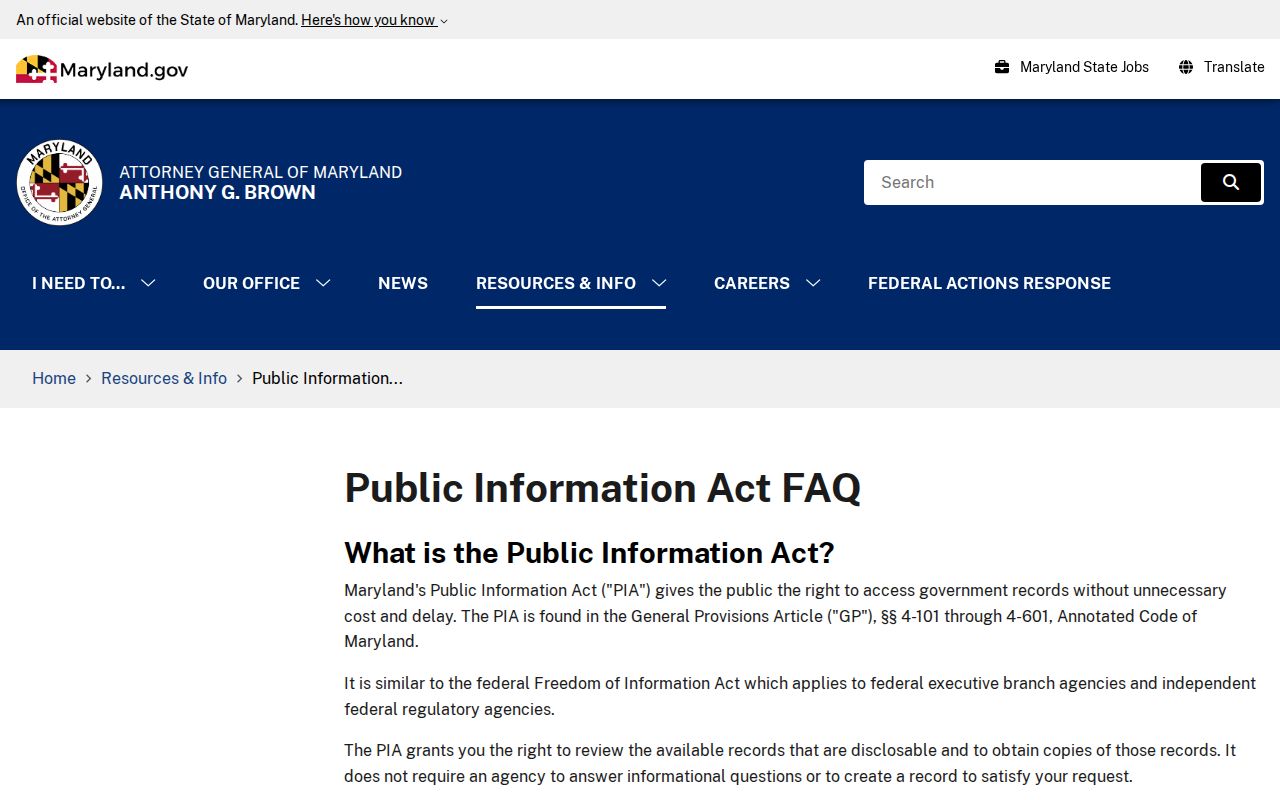
The PIA overview helps you find the right custodian. The agency holding the arrest record still makes the release decision.
- Identify the record and custodian. A jail may hold the booking card, while the arresting agency holds its report.
- Use that agency's PIA route and give the name, approximate date, location, and report number if known.
- Ask for a copy or inspection, request any separable public part, and keep the response.
Maryland PIA Deadlines and Fees
Timing is set by General Provisions §4-203. A custodian must act promptly. The outer limit is 30 days. If the agency cannot produce or deny the record within 10 working days, it must send written notice during those 10 days. The notice must explain the expected timing. It must also give the fee estimate and the reason for delay. Search and preparation are generally free for the first two hours. Charges after that must be reasonable and follow a lawful schedule.
A denial must state its legal basis, identify separable material, and describe remedies. A requester can turn to the Public Access Ombudsman. An eligible PIA Compliance Board review is another option, and so is the court. Meeting a deadline does not force release when a valid exception applies.
Note: Request an existing record from its custodian, since the PIA does not require a new statewide arrest report.
Maryland Arrest Record Exemptions
Access has firm edges. General Provisions §4-301 requires denial in certain cases. Disclosure would break a law, court rule, or court order, or expose privileged or confidential material. The custodian can often redact protected details and release the rest. That is why a booking card and a full investigative file get different treatment.
Section 4-351 lets a custodian withhold certain records. These include police or sheriff investigatory records, intelligence, security procedures, and related material. The grounds matter. Release could harm an investigation or proceeding. It could invade protected privacy, reveal a source or technique, or put someone at risk. Each decision turns on the record and the reason given. No rule says an arrest photograph is always public or always secret.
Juvenile records sit behind a stronger wall. Under Courts and Judicial Proceedings §3-8A-27, police records about a child are confidential and kept apart from adult records. Only defined exceptions apply. Juvenile court files are confidential too and may be sealed. A child's name or image is not ordinary adult arrest material. When age or record status is unclear, ask the custodian about its public-release rule. Do not assume a search result can be republished.
Maryland's Mugshot Website Rule
Maryland treats paid mugshot removal as a consumer problem. The tool is Commercial Law §14-1324. It applies when a website operator charges to take down an arrest or detention photo. Who qualifies? A person whose image became removable through expungement or shielding. Vacatur counts too. So does any other removal from public inspection. The request must be documented. Certified mail works. So does secure email with an electronic postmark, when the site offers one. The operator then has 30 days to pull the photo. Written confirmation follows within five business days. No fee allowed, period. Charging for removal is an unfair or deceptive trade practice under Title 13. That title's enforcement and penalty rules back it up. The statute cannot promise every site cooperates without a fight.
The General Assembly built this remedy in 2015. House Bill 744, Chapter 453, effective October 1, 2015, set the certified-mail route. It also fixed the no-fee rule, the removal window, and the confirmation deadline. Fee-charging sites were the target.
Nothing here forces a county, jail, or police department to post booking photos. It is no blanket ban either. And an accurate article does not vanish just because charges were later reduced or dismissed. The statute acts only when its eligibility conditions are met. A site may still offer broader voluntary corrections on its own.
No Maryland appellate decision has squarely settled the statute's operational deadlines. Lower-court disputes remain possible, so measure any remedy by the law's text.
Maryland Expungement Eligibility
Expungement happens in court, not at a desk. Maryland's adult expungement law covers eligible outcomes. It directs police and court custodians to remove qualifying records under an order. Grounds include acquittal, dismissal, nolle prosequi, probation before judgment, stet, compromise, certain pardons, and a vacated conviction. Nolle prosequi means the prosecutor drops the case. PBJ defers judgment while conditions hold. A stet parks the case on an inactive docket. Eligibility turns on the charge and final outcome, not merely the absence of a conviction.
Waiting periods vary too. Many favorable outcomes carry a three-year wait. Some require completed treatment or supervision first. A DUI PBJ waits longer. A pending criminal case can block the petition. The State's Attorney gets an objection window. Favorable cases often file free, while a petition based on a guilty outcome may carry a fee. Check the live court forms and rules before filing.
The Maryland Courts expungement guide and forms set out the filing route. Keep the order once granted, and follow up with each custodian. If it covers a police or court photograph, the custodian must comply. A copy living on another website is a separate fight.
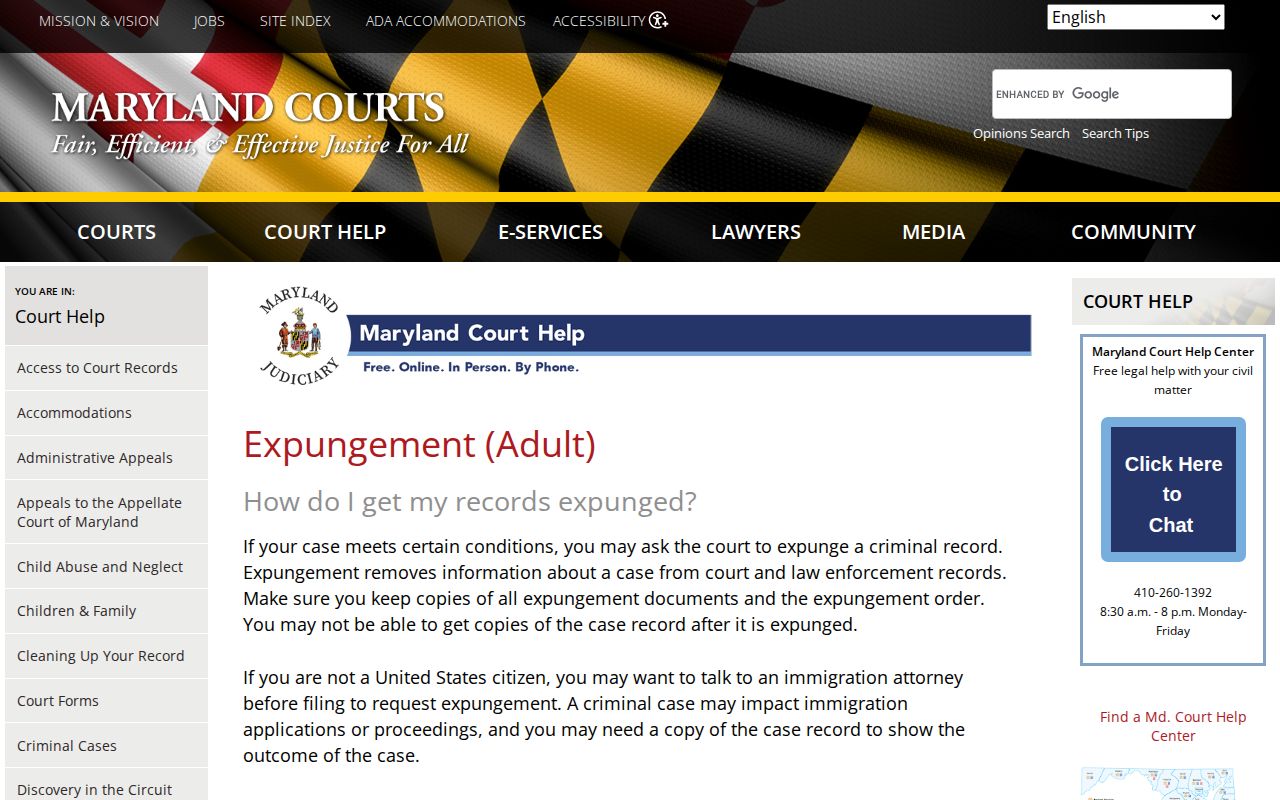
The form page is just a starting point. The court order, not any website summary, controls what happens to the record.
Maryland Shielding and Access
Shielding is a different animal. Maryland Courts describes it as making a qualifying conviction record inaccessible to the general public. Authorized access survives. The rules generally allow one petition. It must go to one county and one court. And the chance comes once in a lifetime. A three-year wait runs after completion of sentence, parole, probation, or mandatory supervision. A pending case or a disqualifying new conviction can block relief. Shielding can pull a case from public Case Search. Not every historical copy is destroyed. The official Maryland shielding guide explains its limits and the case-search effect.
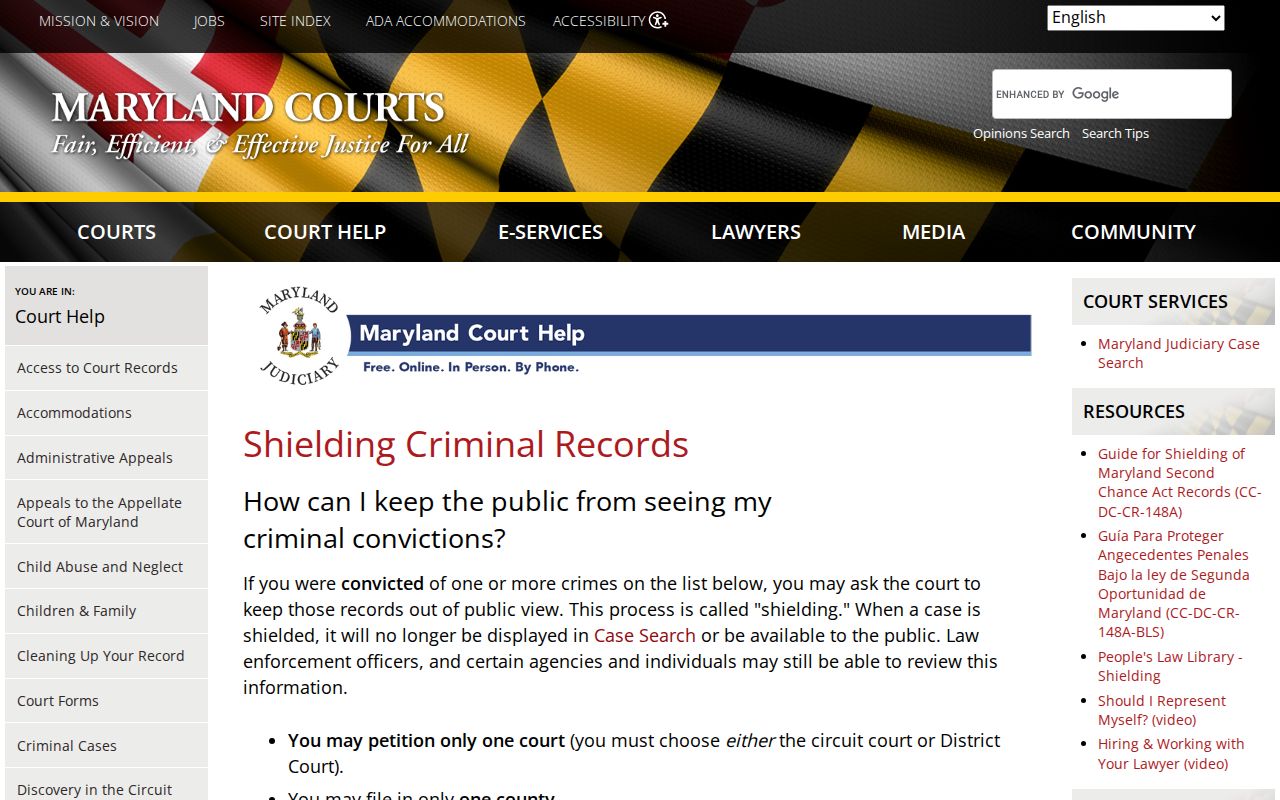
Shielding is not expungement. It does not erase every copy held by an authorized agency or a third party.
Note: A favorable outcome alone does not prove that every court, agency, search engine, and publisher has changed its copy.
Maryland Arrest Photo Opt-Outs
After a court order or verified correction, contact the government custodian first. Then separately request a change from each publisher that copied the image or case details. Section 14-1324 gives a free route for eligible images. Some sites accept wider requests. Wrong person, duplicate, outdated entry, or favorable outcome may qualify. The Busted Newspaper form asks for the listing URL, your identity, and a reason. Legal papers are required for outcomes like expungement, dismissal, or sealing. It seeks no payment. Estimates run five to ten days. The RecentlyBooked policy covers dismissed, expunged, sealed, incorrect, outdated, wrong-person, juvenile, and duplicate entries. Both policies can change. Neither guarantees a result.
A free removal policy does not make a listing official or complete. Keep your request, and compare any response with the court order. Skip intermediaries promising universal erasure. Start with the record holder and each publisher's documented process.
| Record or copy | Practical route |
|---|---|
| Government record | Ask its custodian to apply the court order or correction. |
| Eligible fee-charging site | Send the documented, free §14-1324 request. |
| Aggregator entry | Use its current free form with the URL and supporting records. |
| Search result or cache | Request a stale-result refresh after the source changes; this will not delete the source copy. |
| News story | Use the outlet's correction route; §14-1324 does not compel removal of every accurate story. |
Maryland Arrest Stories and Caches
Newsrooms play by different rules than aggregators. WBOC's published terms say accurate arrest coverage generally stays up even after acquittal or expungement. A correction may be considered when the person was not actually arrested. That is editorial policy, not a statewide removal right. Send the exact story and reliable documents.
A correction does not clear search snippets, reposts, screenshots, or archives. Search-provider stale-content tools fix indexing, not the source record. So each copied page may need its own request.
Maryland Retention Schedules
How long an arrest record survives depends on a schedule, not a single rule. Maryland State Archives lets each agency follow an approved schedule. That schedule decides when records get kept, moved, or destroyed. No one modern period covers every county booking photo. So a jail roster can vanish. The underlying arrest record can still sit in agency files. A record can also be retained yet sealed off from view. For the agency-by-agency framework, the Archives offers its approved-schedules resource.
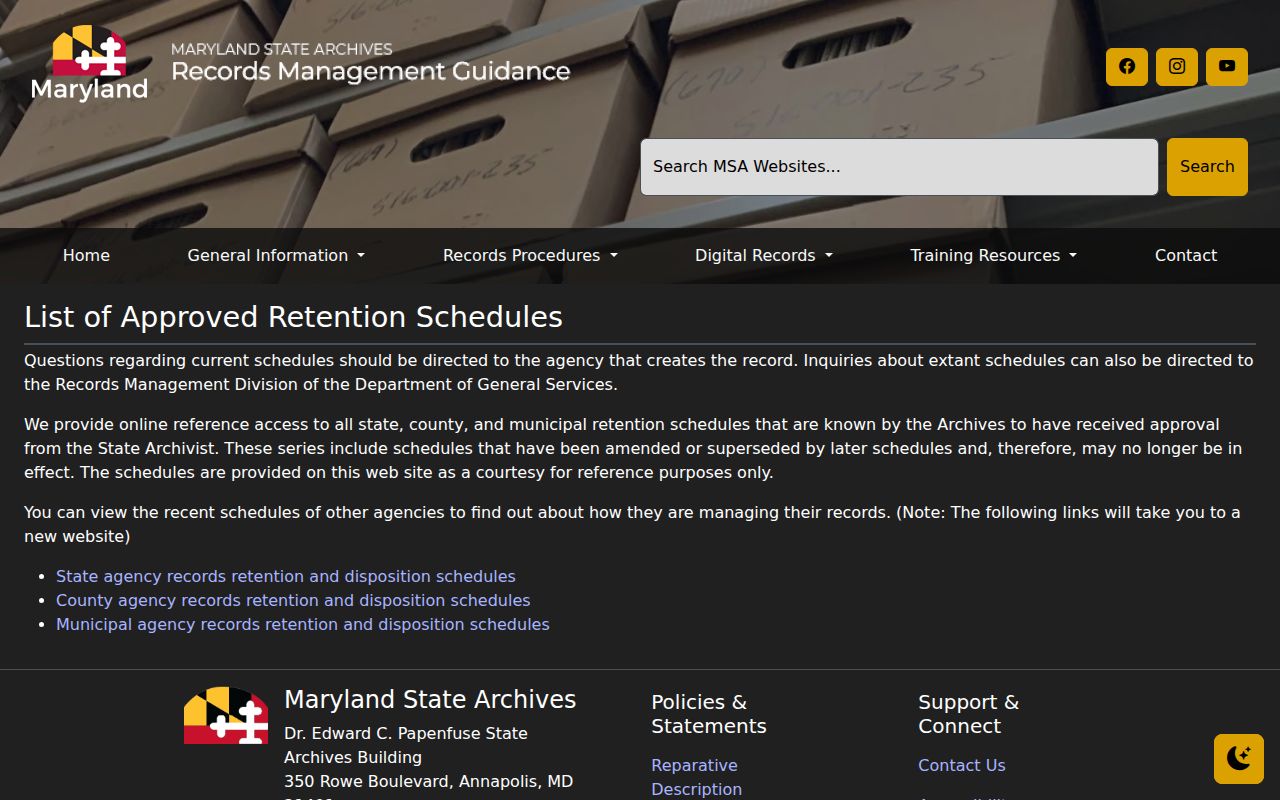
Ask the office that created the record. That is who holds the current schedule. It is not whatever display period a website happens to show. One historical Maryland State Police schedule spelled out a chain for mugshot negatives. They spent ten years in the Criminal Records Central Repository. Then came 25 years at the State Records Center. Destruction came after that. That case is agency-specific. It cannot be stretched to the digital booking photographs held today by every jail or police department. Confirm the current schedule directly with the creating agency.
Maryland Historical Corrections Records
Older corrections holdings go deep. The State Archives' Maryland Penitentiary photographs and film collection reaches from about 1800 to 2004. Its prisoner-records collection, series S275, spans 1811 to 1978. Treat these as historical corrections material rather than a guaranteed mugshot file, since medical photographs are restricted and many items lack an online public copy.
Note: A public roster's removal date, a government retention schedule, and a third-party site's copy are separate records questions.
Why Maryland Arrest Access Varies
Maryland has no full, real-time statewide booking roster. County and Baltimore City systems differ in what fields they show, whether photos appear, and how long a page stays up. Some custody screens display images. Others offer only text, placeholders, or no public photo field at all. A State Police release may point you toward a county detention record. Meanwhile, a citation, a quick release, or a transfer can leave no entry on the first page you search.
A missing photo or roster match proves nothing about whether an image or arrest record exists. For current custody, rely on the locality's official source. For the report itself, go to the arresting agency. For a public disposition, the court is the place. The statewide Maryland mugshot and arrest-source overview maps the official photo channels.
Note: A Maryland arrest record may move between agency, detention, court, and archive systems as the case and custody status change.